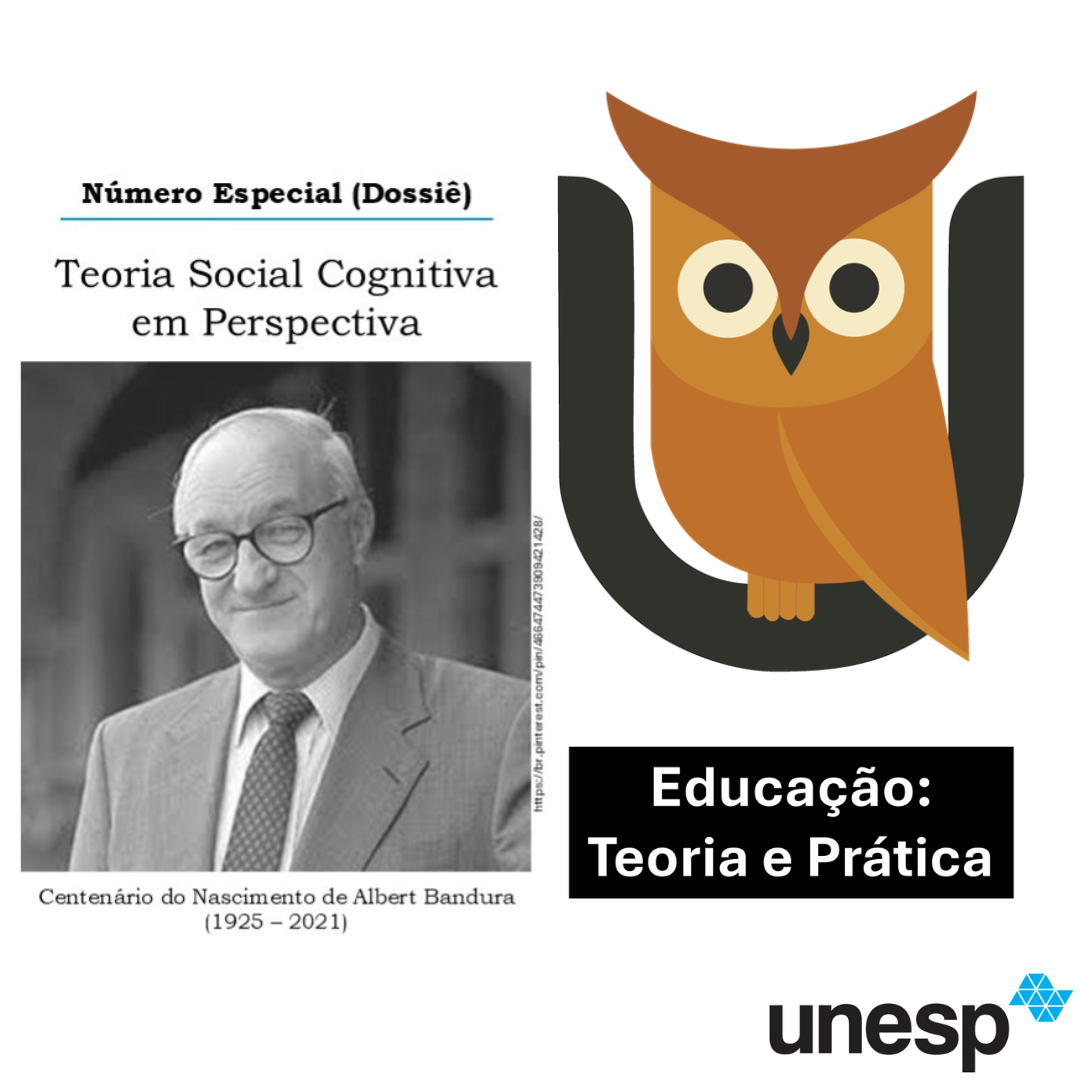
Contribuições de Albert Bandura para a educação
DOI:
https://doi.org/10.18675/1981-8106.v35.n.70.s18997Keywords:
Teoría social cognitiva. Autoeficacia. Aprendizaje observacional. Autorregulación.Abstract
Albert Bandura está entre os maiores psicólogos de todos os tempos. Suas contribuições para a psicologia são numerosas demais para serem listadas em um artigo breve. Notavelmente, ele desenvolveu a teoria social cognitiva a partir de sua predecessora, a teoria da aprendizagem social, que era fortemente baseada no comportamentalismo. Ao incluir variáveis cognitivas e afetivas na teoria social cognitiva, Bandura ampliou significativamente o escopo e a aplicabilidade dessa teoria. A teoria expandida também incorporou a autorregulação e, de forma importante, introduziu o conceito de autoeficácia. Neste artigo, destacamos três das contribuições de Bandura para a educação: modelação e aprendizagem observacional, autoeficácia e autorregulação. As contribuições nessas áreas são especialmente notáveis porque impactaram o desenvolvimento teórico, a pesquisa e a prática. Inicialmente, discutimos o quadro conceitual da teoria social cognitiva, fundamentado em interações recíprocas entre influências pessoais, comportamentais e ambientais. Em seguida, abordamos modelação e aprendizagem observacional, autoeficácia e autorregulação. Para cada tópico, discutimos a teoria e as evidências de pesquisa que a apoiam, juntamente com algumas aplicações. O artigo conclui com sugestões para pesquisas futuras.
References
BANDURA, A. Self-efficacy: the exercise of control. New York: Freeman, 1997.
BANDURA, A. Self-efficacy: toward a unifying theory of behavioral change. Psychological Review, v. 84, n. 2, p. 191-215, 1977a.
BANDURA, A. Social foundations of thought and action: a social cognitive theory. Englewood Cliffs, NJ: Prentice Hall, 1986.
BANDURA, A. Social learning theory. Englewood Cliffs, NJ: Prentice Hall, 1977b.
BANDURA, A.; ROSS, D.; ROSS, S. A. Imitation of film-mediated aggressive models. Journal of Abnormal and Social Psychology, v. 66, n. 1, p. 3-11, 1963.
BANDURA, A.; WALTERS, R. H. Social learning and personality development. New York: Holt, Rinehart & Winston, 1963.
SCHUNK, D. H. Learning theories: an educational perspective. 8th ed. Hoboken, NJ: Pearson Education, 2020.
SCHUNK, D. H. Peer models and children’s behavioral change. Review of Educational Research, v. 57, n. 2, p. 149-174, 1987.
SCHUNK, D. H. Social cognitive theory. In: HARRIS, K. R.; GRAHAM, S.; URDAN, T. (ed.). APA educational psychology handbook. Vol. 1: Theories, constructs and critical issues. Washington, DC: American Psychological Association, 2012. p. 101-123.
SCHUNK, D. H.; DIBENEDETTO, M. K. Self-efficacy and human motivation. In: ELLIOT, A. J. (ed.). Advances in motivation science. Oxfordshire, England: Elsevier, 2021. pp. 153-179.
SCHUNK, D. H.; ZIMMERMAN, B. J. Social origins of self-regulatory competence. Educational Psychologist, v. 32, n. 4, p. 195-208, 1997.
ZIMMERMAN, B. J. Becoming a self-regulated learner: An overview. Theory into Practice, v. 41, n. 2, p. 64-70, 2002. Disponível em: https://doi.org/10.1207/s15430421tip4102_2. Acesso em: 15 jan. 2025.
ZIMMERMAN, B. J.; SCHUNK, D. S. Albert Bandura: the scholar and his contributions to educational psychology. In: ZIMMERMAN, B. J.; SCHUNK, D. H. (ed.). Educational psychology: a century of contributions. Mahwah, NJ: Erlbaum, 2003. p. 421-457.
Downloads
Published
How to Cite
Issue
Section
License
Authors who publish in this journal agree to the following terms:
a) Authors assign copyright to the journal, with the work simultaneously licensed under the Creative Commons Attribution License that allows sharing of the work with acknowledgment of authorship and publication in this journal.
b) The policy adopted by the Editorial Committee is to assign copyright only after a period of 30 months from the date of publication of the article. After this time, authors interested in publishing the same text in another work must send a letter to the Editorial Committee requesting the release of the assignment of copyright and wait for a response.
c) This journal provides public access to all its content, since this allows greater visibility and reach of published articles and reviews. For more information on this approach, visit the Public Knowledge Project, a project that developed this system to improve the academic and public quality of research, by distributing OJS as well as other software to support the public access publication system to academic sources. The names and email addresses on this website will be used exclusively for the purposes of the journal and will not be available for other purposes. This journal provides open any other party  This work is licensed under a Creative Commons License