O Papel da Agência Pessoal no Programa de Empoderamento de Autorregulação (SREP): Influência da Teoria Social Cognitiva
DOI:
https://doi.org/10.18675/1981-8106.v35.n.70.s19002Keywords:
Teoria social cognitiva. Aprendizagem autorregulada. Agência. Autoeficácia. Intervenção educacional.Abstract
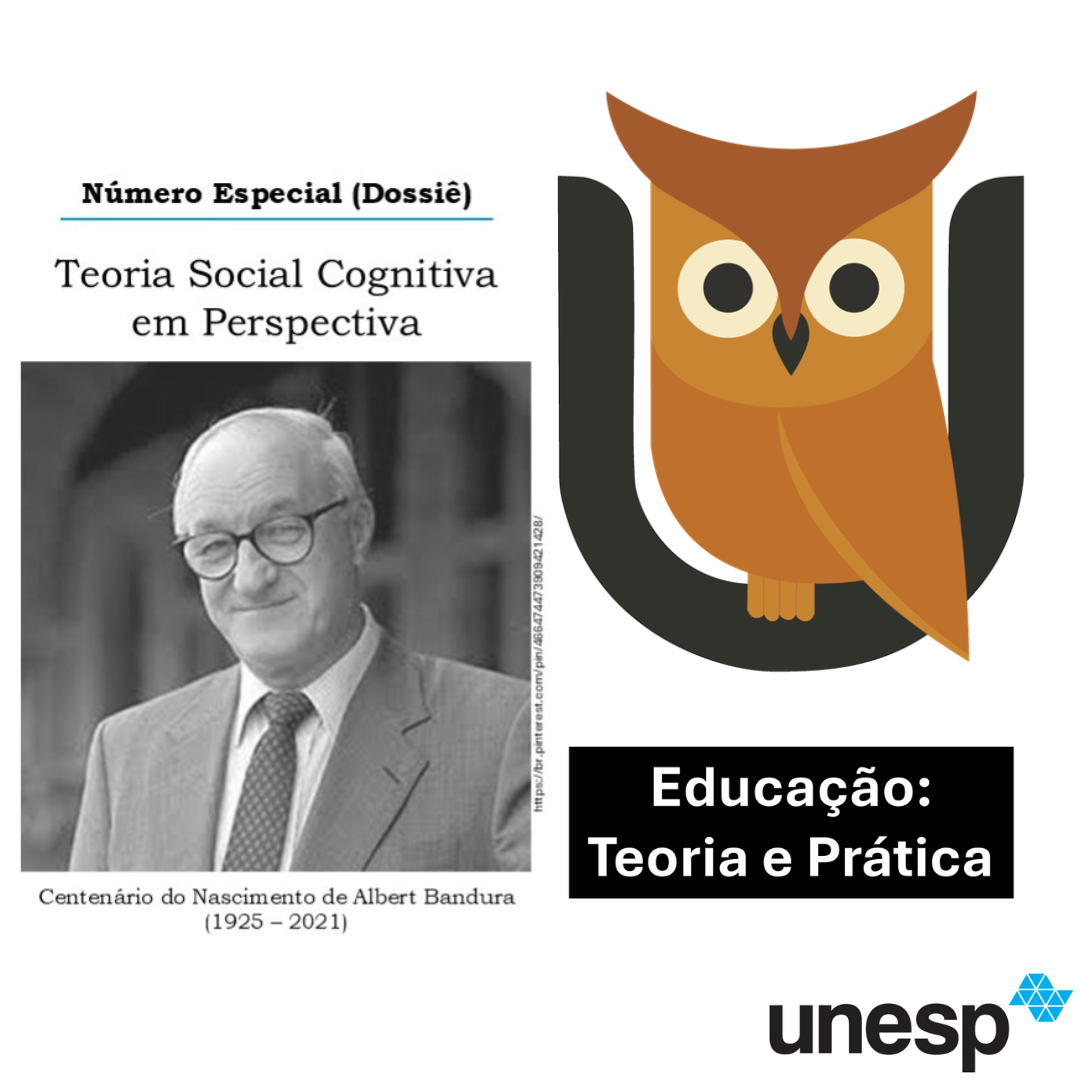
Albert Bandura é um dos psicólogos e pesquisadores mais prolíficos e influentes da história. Além de defender a importância das percepções das pessoas sobre sua própria capacidade (ou seja, autoeficácia), Bandura desenvolveu uma perspectiva complexa, ampla e geradora sobre a personalidade (a Teoria Social Cognitiva [TSC]), que destaca o potencial humano de agir com propósito, intencionalidade e agência no mundo em que vive. Neste artigo, reviso os princípios e mecanismos centrais incorporados à TSC que estimulam e cultivam essa noção de agência pessoal, como autoeficácia, regulação cíclica, reciprocidade triádica e aprendizagem observacional. Em seguida, discuto como esses princípios que promovem a agência foram utilizados para desenvolver os procedimentos e atividades de um programa acadêmico aplicado, projetado para otimizar a motivação de estudantes do ensino fundamental e médio, a aprendizagem autorregulada e o desempenho acadêmico. Ao relacionar os princípios fundamentais de Bandura às atividades de uma intervenção escolar, espero destacar como educadores e profissionais que atuam em escolas podem, de forma semelhante, aplicar os princípios da TSC em seu papel profissional.
References
BANDURA, A. Self-efficacy: the exercise of control. New York, NY: W. H. Freeman, 1997.
BANDURA, A. Social cognitive theory: an agentic perspective on human nature. Wiley, 2023.
BANDURA, A. Social foundations of thought and action: a social cognitive theory. Prentice-Hall, Inc, 1986.
CLEARY, T. J. Social validity perceptions of the Self-Regulation Empowerment Program (SREP): a qualitative investigation. Journal of Applied School Psychology, v. 37, n. 1, p. 16-42, 2021. DOI: https://doi.org/10.1080/15377903.2020.1772433.
CLEARY, T. J.; KITSANTAS, A. Motivation and self-regulated learning influences on middle school mathematics achievement. School Psychology Review, v. 46, p. 88-107, 2017. DOI:10.17105/SPR46-1.88-107.
CLEARY, T. J.; KITSANTAS, A.; PAPE, S.; SLEMP, J. Integration of socialization influences and the development of self-regulated learning skills: A social-cognitive perspective. In: LIEM, G. A.; MCINERNEY, D. M. (ed.), Big theories revisited. 2. ed. Charlotte, NC: Information Age Publishing, 2018. p. 269-294.
CLEARY, T. J.; PLATTEN, P. Examining the correspondence between self-regulated learning and academic achievement: A case study analysis [Special Issue]. Educational Research International, v. 2013, artigo 272560, 2013. DOI: 10.1155/2013/272560.
CLEARY, T. J.; PLATTEN, P.; NELSON, A. Effectiveness of the Self-Regulation Empowerment Program with urban high school students. Journal of Advanced Academics, v. 20, n. 1, p. 70-107, 2008.
CLEARY, T. J.; RUSSO, M. R. A multi-level framework for assessing self-regulated learning in school contexts: Innovations, challenges, and future directions. Psychology in the Schools, v. 61, n. 1, p. 80-102, 2024. DOI: https://doi.org/10.1002/pits.23035.
CLEARY, T. J.; SLEMP. J.; REDDY, L.; ALPERIN, A.; LUI, A.; AUSTIN, A.; CEDAR, T. Characteristics and uses of SRL microanalysis across diverse contexts, tasks, and populations: a systematic review. School Psychology Review, v. 52, n. 2, p. 159-179, 2023. DOI:10.1080/2372966X.2020.1862627
CLEARY, T. J.; VELARDI, B.; SCHNAIDMAN, B. Effects of the Self-Regulated Learning Empowerment Program on middle school students’ strategic skills, self-efficacy, and mathematics achievement. Journal of School Psychology, v. 64, p. 28-42, 2017. DOI:10.1016/j.jsp.2017.04.004
GRAHAM, S.; HARRIS, K. R. Almost 30 years of writing research: Making sense of it all with The Wrath of Khan. Learning Disabilities Research & Practice, v. 24, n. 2, p. 58-68, 2009. DOI: https://doi.org/10.1111/j.1540-5826.2009.01277.x.
PAJARES, F.; GRAHAM, L. Self-efficacy, motivation constructs, and mathematics performance of entering middle school students. Contemporary Educational Psychology, v. 24, p. 124-139, 1999.
PAJARES, F.; KRANZLER, J. Self-efficacy beliefs and general mental ability in mathematical problem-solving. Contemporary Educational Psychology, v. 20, n. 4, p. 426-443, 1995. DOI: https://doi.org/10.1006/ceps.1995.1029.
PANADERO, E. A review of self-regulated learning: six models and four directions for research. Frontiers in Psychology, v. 8, artigo 422, 2017. DOI: https://doi.org/10.3389/fpsyg.2017.00422.
PERKINS, D. D.; ZIMMERMAN, M. A. Empowerment theory, research, and application. American Journal of Community Psychology, v. 23, p. 569-579, 1995.
PINTRICH, P. R. The role of goal orientation in self-regulated learning. In: BOEKAERTS, M.; PINTRICH, P.; ZEIDNER, M. (ed.), Handbook of self-regulation. Orlando, FL: Academic Press, 2000. p. 452-502.
SAKIZ, G.; PAPE, S. J.; WOOLFOLK HOY, A. Does perceived teacher affective supports matter for middle school students in mathematics classrooms? Journal of School Psychology, v. 50, p. 235-255, 2012. DOI: 10.1016/j.jsp.2011.10.005.
SCHUNK, D. H. Learning theories: an educational perspective. 6. ed. Pearson Education Inc, 2014.
SCHUNK, D. H. Self-efficacy for reading and writing: Influence of modeling, goal setting, and self-evaluation. Reading and Writing Quarterly, v. 19, p. 159-172, 2003. DOI: https://doi.org/10.1080/10573560308219.
SCHUNK, D. H.; HANSON, A. R. Peer models: influence on children's self-efficacy and achievement. Journal of Educational Psychology, v. 77, n. 3, p. 313-322, 1985. DOI: https://doi.org/10.1037/0022-0663.77.3.313.
SCHUNK, D. H.; ZIMMERMAN, B. J. Social origins of self-regulatory competence. Educational Psychologist, v. 32, n. 4, p. 195-208, 1997. DOI: https://doi.org/10.1207/s15326985ep3204_1.
ZIMMERMAN, M. A. Empowerment theory: Psychological, organizational, and community levels of analysis. In: RAPPAPORT, J.; SEIDMAN, E. (ed.). Handbook of community psychology. Kluwer Academic Publishers, 2000. p. 43-63. DOI: https://doi.org/10.1007/978-1-4615-4193-6_2.
ZIMMERMAN, B. J. Attaining self-regulation: A social-cognitive perspective. In: BOEKAERTS, M.; PINTRICH, P.; ZEIDNER, M. (ed.). Handbook of self-regulation. Academic Press, 2000. p. 13-39.
ZIMMERMAN, B. J.; BONNER, S.; KOVACH, R. Developing self-regulated learners: beyond achievement to self-efficacy. American Psychological Association, 1996. DOI: https://doi.org/10.1037/10213-000
ZIMMERMAN, B. J.; KITSANTAS, A. Acquiring writing revision and self-regulatory skill through observation and emulation. Journal of Educational Psychology, v. 94, n. 4, p. 660-668, 2002. DOI: https://doi.org/10.1037/0022-0663.94.4.660.
ZIMMERMAN, B. J.; KITSANTAS, A. Homework practices and academic achievement: The mediating role of self-efficacy and perceived responsibility beliefs. Contemporary Educational Psychology, v. 30, n. 4, p. 397-417, 2005. DOI: https://doi.org/10.1016/j.cedpsych.2005.05.003.
Downloads
Published
How to Cite
Issue
Section
License
Authors who publish in this journal agree to the following terms:
a) Authors assign copyright to the journal, with the work simultaneously licensed under the Creative Commons Attribution License that allows sharing of the work with acknowledgment of authorship and publication in this journal.
b) The policy adopted by the Editorial Committee is to assign copyright only after a period of 30 months from the date of publication of the article. After this time, authors interested in publishing the same text in another work must send a letter to the Editorial Committee requesting the release of the assignment of copyright and wait for a response.
c) This journal provides public access to all its content, since this allows greater visibility and reach of published articles and reviews. For more information on this approach, visit the Public Knowledge Project, a project that developed this system to improve the academic and public quality of research, by distributing OJS as well as other software to support the public access publication system to academic sources. The names and email addresses on this website will be used exclusively for the purposes of the journal and will not be available for other purposes. This journal provides open any other party  This work is licensed under a Creative Commons License