El papel de la agencia personal en el Programa de Empoderamiento de la Autorregulación (SREP): Influencia de la Teoría Cognitiva Social
DOI:
https://doi.org/10.18675/1981-8106.v35.n.70.s19002Palabras clave:
Teoría social cognitiva. Aprendizaje autorregulado. Agencia. Autoeficacia. Intervención educacional.Resumen
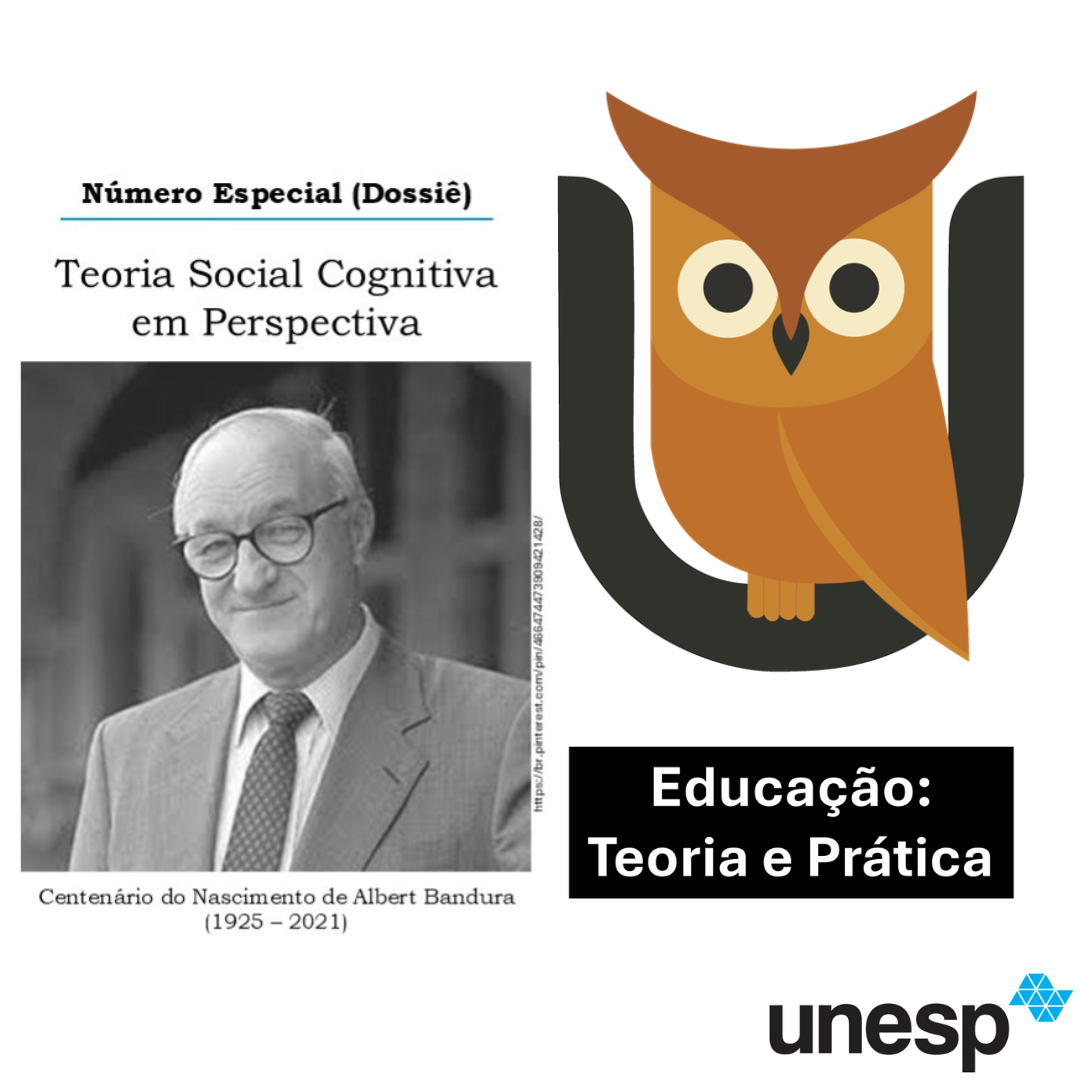
Albert Bandura es uno de los psicólogos e investigadores más prolíficos e influyentes de la historia. Además de defender la importancia de las percepciones de las personas sobre su propia capacidad (es decir, la autoeficacia), Bandura desarrolló una perspectiva compleja, amplia y generativa sobre la personalidad (la Teoría Social Cognitiva [TSC]) que destaca el potencial humano para actuar con propósito, intencionalidad y agencia en el mundo en el que vive. En este artículo, reviso los principios y mecanismos centrales incorporados a la TSC que estimulan y cultivan esta noción de agencia personal, como la autoeficacia, la autorregulación cíclica, la reciprocidad triádica y el aprendizaje observacional. Luego, discuto cómo estos principios que fomentan la agencia se utilizaron para desarrollar los procedimientos y actividades de un programa académico aplicado, diseñado para optimizar la motivación de los estudiantes de secundaria, el aprendizaje autorregulado y el rendimiento académico. Al relacionar los principios fundamentales de Bandura con las actividades de una intervención escolar, espero destacar cómo los educadores y profesionales que trabajan en escuelas pueden, de manera similar, aplicar los principios de la TSC en su rol profesional.
Citas
BANDURA, A. Self-efficacy: the exercise of control. New York, NY: W. H. Freeman, 1997.
BANDURA, A. Social cognitive theory: an agentic perspective on human nature. Wiley, 2023.
BANDURA, A. Social foundations of thought and action: a social cognitive theory. Prentice-Hall, Inc, 1986.
CLEARY, T. J. Social validity perceptions of the Self-Regulation Empowerment Program (SREP): a qualitative investigation. Journal of Applied School Psychology, v. 37, n. 1, p. 16-42, 2021. DOI: https://doi.org/10.1080/15377903.2020.1772433.
CLEARY, T. J.; KITSANTAS, A. Motivation and self-regulated learning influences on middle school mathematics achievement. School Psychology Review, v. 46, p. 88-107, 2017. DOI:10.17105/SPR46-1.88-107.
CLEARY, T. J.; KITSANTAS, A.; PAPE, S.; SLEMP, J. Integration of socialization influences and the development of self-regulated learning skills: A social-cognitive perspective. In: LIEM, G. A.; MCINERNEY, D. M. (ed.), Big theories revisited. 2. ed. Charlotte, NC: Information Age Publishing, 2018. p. 269-294.
CLEARY, T. J.; PLATTEN, P. Examining the correspondence between self-regulated learning and academic achievement: A case study analysis [Special Issue]. Educational Research International, v. 2013, artigo 272560, 2013. DOI: 10.1155/2013/272560.
CLEARY, T. J.; PLATTEN, P.; NELSON, A. Effectiveness of the Self-Regulation Empowerment Program with urban high school students. Journal of Advanced Academics, v. 20, n. 1, p. 70-107, 2008.
CLEARY, T. J.; RUSSO, M. R. A multi-level framework for assessing self-regulated learning in school contexts: Innovations, challenges, and future directions. Psychology in the Schools, v. 61, n. 1, p. 80-102, 2024. DOI: https://doi.org/10.1002/pits.23035.
CLEARY, T. J.; SLEMP. J.; REDDY, L.; ALPERIN, A.; LUI, A.; AUSTIN, A.; CEDAR, T. Characteristics and uses of SRL microanalysis across diverse contexts, tasks, and populations: a systematic review. School Psychology Review, v. 52, n. 2, p. 159-179, 2023. DOI:10.1080/2372966X.2020.1862627
CLEARY, T. J.; VELARDI, B.; SCHNAIDMAN, B. Effects of the Self-Regulated Learning Empowerment Program on middle school students’ strategic skills, self-efficacy, and mathematics achievement. Journal of School Psychology, v. 64, p. 28-42, 2017. DOI:10.1016/j.jsp.2017.04.004
GRAHAM, S.; HARRIS, K. R. Almost 30 years of writing research: Making sense of it all with The Wrath of Khan. Learning Disabilities Research & Practice, v. 24, n. 2, p. 58-68, 2009. DOI: https://doi.org/10.1111/j.1540-5826.2009.01277.x.
PAJARES, F.; GRAHAM, L. Self-efficacy, motivation constructs, and mathematics performance of entering middle school students. Contemporary Educational Psychology, v. 24, p. 124-139, 1999.
PAJARES, F.; KRANZLER, J. Self-efficacy beliefs and general mental ability in mathematical problem-solving. Contemporary Educational Psychology, v. 20, n. 4, p. 426-443, 1995. DOI: https://doi.org/10.1006/ceps.1995.1029.
PANADERO, E. A review of self-regulated learning: six models and four directions for research. Frontiers in Psychology, v. 8, artigo 422, 2017. DOI: https://doi.org/10.3389/fpsyg.2017.00422.
PERKINS, D. D.; ZIMMERMAN, M. A. Empowerment theory, research, and application. American Journal of Community Psychology, v. 23, p. 569-579, 1995.
PINTRICH, P. R. The role of goal orientation in self-regulated learning. In: BOEKAERTS, M.; PINTRICH, P.; ZEIDNER, M. (ed.), Handbook of self-regulation. Orlando, FL: Academic Press, 2000. p. 452-502.
SAKIZ, G.; PAPE, S. J.; WOOLFOLK HOY, A. Does perceived teacher affective supports matter for middle school students in mathematics classrooms? Journal of School Psychology, v. 50, p. 235-255, 2012. DOI: 10.1016/j.jsp.2011.10.005.
SCHUNK, D. H. Learning theories: an educational perspective. 6. ed. Pearson Education Inc, 2014.
SCHUNK, D. H. Self-efficacy for reading and writing: Influence of modeling, goal setting, and self-evaluation. Reading and Writing Quarterly, v. 19, p. 159-172, 2003. DOI: https://doi.org/10.1080/10573560308219.
SCHUNK, D. H.; HANSON, A. R. Peer models: influence on children's self-efficacy and achievement. Journal of Educational Psychology, v. 77, n. 3, p. 313-322, 1985. DOI: https://doi.org/10.1037/0022-0663.77.3.313.
SCHUNK, D. H.; ZIMMERMAN, B. J. Social origins of self-regulatory competence. Educational Psychologist, v. 32, n. 4, p. 195-208, 1997. DOI: https://doi.org/10.1207/s15326985ep3204_1.
ZIMMERMAN, M. A. Empowerment theory: Psychological, organizational, and community levels of analysis. In: RAPPAPORT, J.; SEIDMAN, E. (ed.). Handbook of community psychology. Kluwer Academic Publishers, 2000. p. 43-63. DOI: https://doi.org/10.1007/978-1-4615-4193-6_2.
ZIMMERMAN, B. J. Attaining self-regulation: A social-cognitive perspective. In: BOEKAERTS, M.; PINTRICH, P.; ZEIDNER, M. (ed.). Handbook of self-regulation. Academic Press, 2000. p. 13-39.
ZIMMERMAN, B. J.; BONNER, S.; KOVACH, R. Developing self-regulated learners: beyond achievement to self-efficacy. American Psychological Association, 1996. DOI: https://doi.org/10.1037/10213-000
ZIMMERMAN, B. J.; KITSANTAS, A. Acquiring writing revision and self-regulatory skill through observation and emulation. Journal of Educational Psychology, v. 94, n. 4, p. 660-668, 2002. DOI: https://doi.org/10.1037/0022-0663.94.4.660.
ZIMMERMAN, B. J.; KITSANTAS, A. Homework practices and academic achievement: The mediating role of self-efficacy and perceived responsibility beliefs. Contemporary Educational Psychology, v. 30, n. 4, p. 397-417, 2005. DOI: https://doi.org/10.1016/j.cedpsych.2005.05.003.
Descargas
Publicado
Cómo citar
Número
Sección
Licencia
Os Autores que publicam nessa revista concordam com os seguintes termos:
a) Os autores cedem os direitos autorais à revista, com o trabalho simultaneamente licenciado sob a Creative Commons Attribution License que permite o compartilhamento do trabalho com reconhecimento da sua autoria e publicação nesta revista.
b) A política adotada pela Comissão Editorial é a de ceder os direitos autorais somente após um período de 30 meses da data de publicação do artigo. Transcorrido esse tempo, os autores interessados em publicar o mesmo texto em outra obra devem encaminhar uma carta à Comissão Editorial solicitando a liberação de cessão dos direitos autorais e aguardar resposta.
c) Esta revista proporciona acesso público a todo o seu conteúdo, uma vez que isso permite uma maior visibilidade e alcance dos artigos e resenhas publicados. Para maiores informações sobre esta abordagem, visite Public Knowledge Project, projeto que desenvolveu este sistema para melhorar a qualidade acadêmica e pública da pesquisa, distribuindo o OJS assim como outros softwares de apoio ao sistema de publicação de acesso público a fontes acadêmicas. Os nomes e endereços de e-mail neste site serão usados exclusivamente para os propósitos da revista, não estando disponíveis para outros fins. This journal provides open any other party  Esta obra está licenciada sob uma Licença Creative Commons